By Anneliese Wildermuth
When the internet heard from the official KitKat Instagram page on April 1st that someone stole 12 tons of KitKats, people assumed it was an April fool’s joke. However, Nestle quickly confirmed that this indeed happened. On March 29th, a transit truck with twelve tons, or 413,793 KitKats, was stolen between its route from central Italy to Poland. In response to the crisis, KitKat launched a “Stolen KitKat Tracker” to allow customers to ensure their candy is not a product of the stolen supply. This was a way for KitKat to not only respond to a crisis but also add a humorous edge to ease any customer worry and make it more of a lighthearted memory.
This tracker is an exemplary example of successful crisis PR; On one hand, the tracker helps Nestle find the stolen KitKats, and at the same time, it increases sales. Customers have a new incentive to buy KitKats to either recreate internet jokes or to see if the candy they buy is part of the sought-out stolen batch.
The response to the heist has gained social media traction as businesses and creators have posted themselves hiding their supply of KitKats suspiciously as a joke. For example, appliance company Curry’s posted a viral video making a joke about the KitKats. The video, which currently has 214,000 likes and 84,600 shares, has become Curry’s most viral video on their Instagram page. Through the tactic of participating in social media trends related to KitKat, businesses such as Curry’s have gained a new spotlight and recognition from the public.
Overall, Nestle’s customer-focused response through direct participation of consumers is a useful strategy that other PR campaigns should learn from. It is through that direct connection to the public that companies, such as Nestle, can highlight that they are for the people, not for the profit.
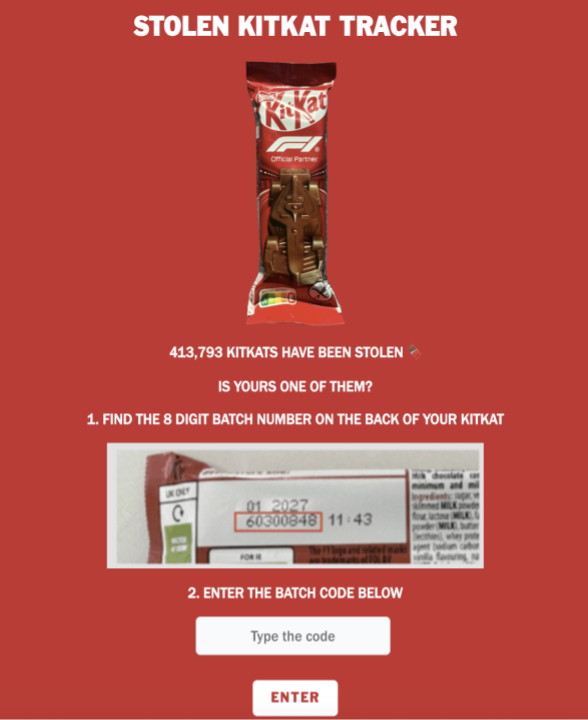
Directions from KitKat’s tracker website show customers how to see if their KitKat was one of the stolen ones.
